New Door and Frame Installation
New and replacement doors, frames, and the prep that decides whether either lasts.
What this covers →Ask a property manager how many doors are in their building and you usually get a pause, then a guess, then a number that is low by about a third.
Tell us the building and the opening.
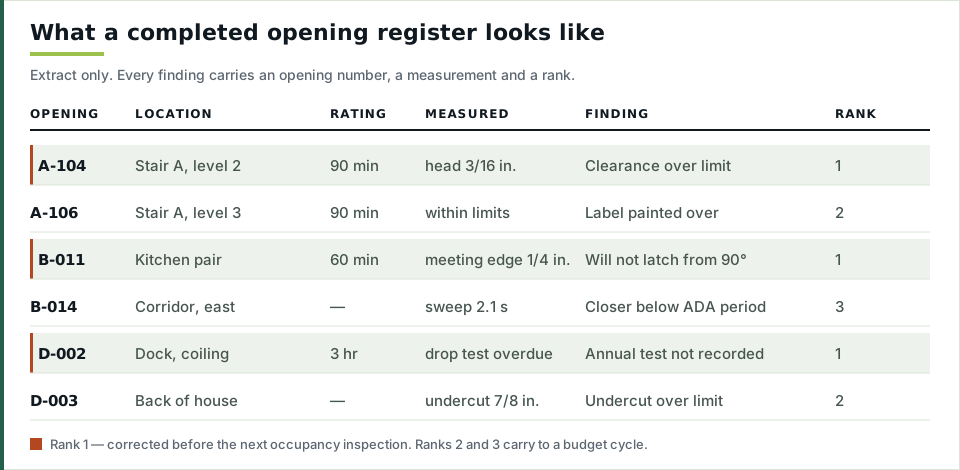
Add a row per opening and print it. This is the same structure we hand back after a survey: an opening number, where it is, what it is rated for, what was measured, what was found and how urgent the correction is. It is built in your browser, nothing is sent anywhere, and closing the page discards it.
| Measurement | Limit |
|---|---|
| 1 — life safety or egress | Correct before the next occupancy inspection. |
| 2 — likely to fail within a year | Carry to a budget cycle. |
| 3 — cosmetic, safe to defer | Record it and leave it. |
| Opening | Location | Rating | Measured | Finding | Rank | Remove |
|---|
A register is only useful if it is kept. The value is not the first survey, it is that next year's inspection appends to the same rows instead of starting over.
That is not carelessness. Openings are invisible until one of them stops working. Nobody budgets for a door. Nobody walks a building counting them. So the exit device on a stair door goes eleven years without anyone touching it, the coiling door at the loading dock gets chained open because it binds, and the rated pair between the corridor and the kitchen has a wedge under it that has been there long enough to leave a mark on the tile.
Then somebody schedules an inspection and all of it surfaces at once.
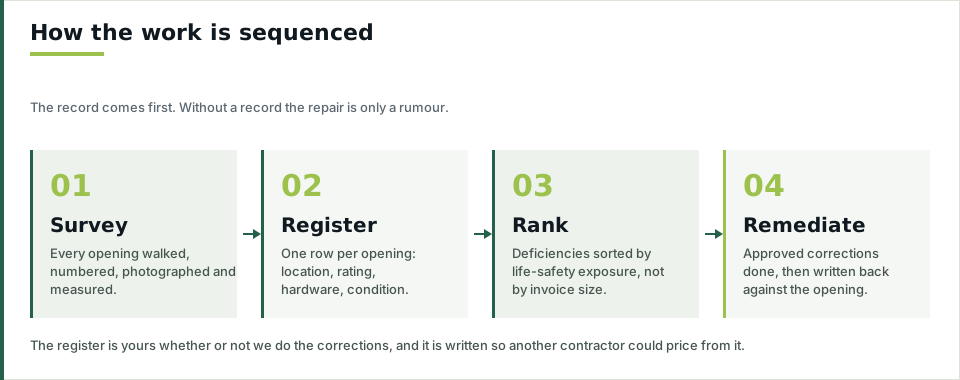
Charlotte Commercial Door Co. works the other direction. The first visit is a survey: every opening walked, numbered, photographed, and written down with its condition and its rating if it carries one. What comes back is a register, not a quote. The register says what has to be corrected now, what can wait for a budget cycle, and what is fine and should be left alone.
Almost every call that arrives naming one component turns out to involve at least two. The hardware is bolted to a leaf, the leaf hangs on hinges, the hinges are anchored in a frame, and the frame is set in a wall that has been moving quietly since the building went up. Change any one of those and the others report it.
That is why a lock that will not catch is so often a hinge that has dropped the leaf an eighth of an inch, and why a closer that seems too strong is frequently a door being asked to overcome a strike it is no longer aligned with.
Five lines of work, chosen to cover an opening across its whole life rather than to catch every possible call. New and replacement doors and frames. Fire-rated assemblies and their annual inspection. Access control and electrified hardware. Coiling and sectional doors at the dock. And the hardware itself, which is where most failures actually live. Each page walks the failure patterns, the code that governs them, and what genuinely moves a price.
New and replacement doors, frames, and the prep that decides whether either lasts.
What this covers →Annual NFPA 80 inspection, written documentation, and the corrections that follow.
What this covers →Electric strikes, electrified devices, mag locks, power transfer, and the egress rules over all of it.
What this covers →Coiling service doors, sectional overheads, rolling steel fire doors, and their drop tests.
What this covers →Closers, exit devices, locksets, hinges, thresholds, and the adjustments that keep them working.
What this covers →Harlan Stancil spent fourteen years in facilities for a regional school district, and for nine of those the fire door program was his to answer for. He was the person standing next to the inspector. He was also the person who worked out, one building at a time, that the district had no idea how many rated openings it owned, and that contractor invoices going back a decade described work on doors nobody could locate.
The survey that fixed it took four months and produced a spreadsheet with just over nine hundred rows.
What it made obvious was that the expensive part had never been the repairs. It was the not knowing. Openings corrected twice because nobody recorded the first time. Doors replaced whole when the frame was the problem. Rated assemblies quietly voided by a maintenance tech drilling for a new lockset with the best intentions in the world.
He left in 2019 and started taking this work under his own name. The rule has not moved since: the record comes first, the repair comes second, and without a record the repair is only a rumor.

The metro reaches across a state line and four counties, and the building stock changes character as you move through it. Uptown towers run stair doors and elevator lobby pairs, usually already under a facilities contract. South End is warehouse conversions where the original coiling doors are still hanging and the tenant improvement drawings pretend they are not. The corridors out toward Concord and Indian Trail are newer retail, mostly aluminum storefront on builder-grade closers that arrived out of adjustment and stayed that way.
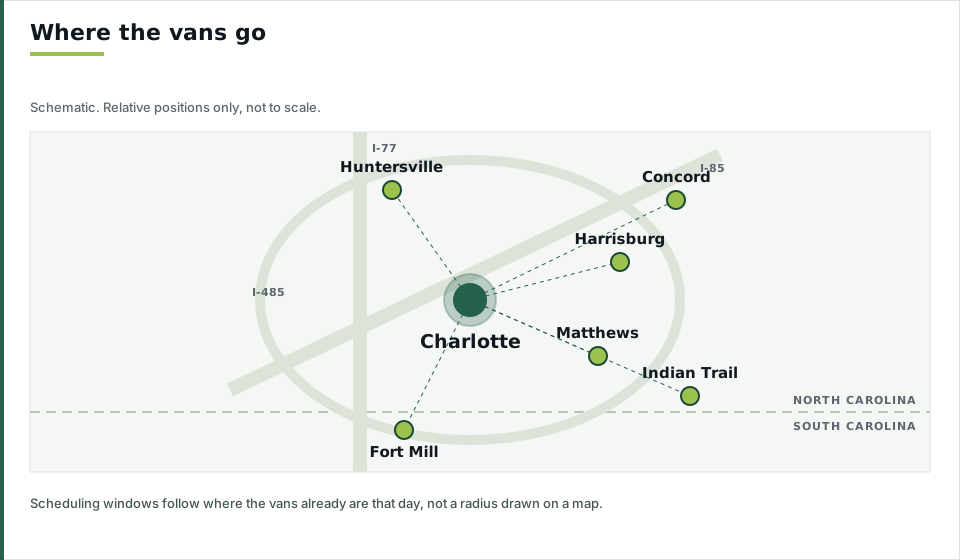
Beyond the city line we work Concord, Huntersville, Indian Trail, Fort Mill, Matthews, and Harrisburg. Give the coordinator a precise address and a suite number. Travel across this metro is not symmetrical, and the scheduling window depends on which side of I-77 the crew is already working.
Annually under NFPA 80, and the inspection has to be documented in writing and kept available. The written record is the part that gets buildings cited, more often than the doors themselves.
Clearances and labels. NFPA 80 caps the gap at the head and jambs at 1/8 inch, the meeting edges of a pair at that same 1/8 inch with a 1/16 inch tolerance, and the undercut at 3/4 inch where there is no threshold. Floors get recarpeted, the undercut changes, and nobody re-measures. After that it is painted-over labels, doors that will not latch from a full open position, and hardware that is not listed for a rated assembly.
Yes, and that is a conflict worth watching in any vendor. The finding sheet is written so somebody else could price from it, and we will hand it over if you want a second number.
Undercutting to the limit on the label is usually permitted. Trimming the top or the width generally is not, and a hole cut through a steel fire door cannot be filled with body filler. The label governs, not the general rule, and the label is on the hinge edge.
It can be. ADA 2010 Standards section 404.2.8.1 requires a closer to take at least five seconds to bring the door from 90 degrees to 12 degrees from the latch. Most doors that fail it fail on adjustment rather than on the closer.
Yes. It is real labor and it produces a document you keep.
Address with suite, a contact who can get us into locked areas, whether there is a landlord or property management approval step, and any certificate of insurance or vendor onboarding requirement. That last one delays more jobs than anything technical.
Give the coordinator the building, roughly how many openings you think you have, and what prompted the call.