Count the Openings. Then Talk About Fixing Them. Speak to the coordinator: (333) 333 333
Who runs this

About Charlotte Commercial Doors


Questions about scope, scheduling, or vendor onboarding.

A door company that started on the client side of the invoice


Most door contractors are founded by technicians. This one was founded by the person who used to hire technicians, review their invoices, and stand beside the inspector when the findings came back. That origin shapes nearly everything about how the work is organized.

It is why the survey exists. It is why the finding sheet is written to be readable by somebody who does not work in the trade. And it is why nobody here will quote a replacement door without a measurement written next to it.

Background

How it started


Wendell Pharr took a facilities coordinator job in 2005 expecting to spend his career on rooftop units and roofing. Within three years the fire door program had landed on his desk because nobody else wanted it.

The first inspection he ran on his own produced eighty-one deficiencies across two buildings. He remembers the number because he spent the following week trying to work out which of them were dangerous and which were paperwork, and finding that nothing in the report told him.

The district-wide survey came later, and it is the thing that eventually became this business. Four months, every building, every opening walked and numbered. Just over nine hundred rows when it was finished. Roughly a fifth of the rated openings carried hardware that was not listed for a rated assembly, most of it fitted by maintenance staff who had no particular reason to know that mattered.

The other finding was quieter and more expensive. Openings had been corrected twice, sometimes three times, across different contractors and different budget years, because no record survived from one repair to the next. The district had been paying to rediscover the same doors.

Charlotte Commercial Doors opened in 2019 with one van, a laser level, a gap gauge, and a rule about writing things down.

The crew is five now. It has expanded more slowly than it might have, largely because a survey-first model means turning away work that arrives wanting a door swapped this week with no questions asked.
The crew

The people who show up


Wendell Pharr

Owner and Fire Door Inspector

Wendell handles surveys, rated assemblies, and anything likely to end up in front of an authority having jurisdiction. Fourteen years in school district facilities gave him an unusual perspective for a contractor: he has been the customer, and he has been the customer being sold something unnecessary. His standing rule is that no deficiency goes on a sheet without a measurement or a photograph beside it. He keeps bees, badly.

Priya Raghunathan

Compliance Records Coordinator

Priya owns the register. Every opening we survey gets numbered, tagged, and filed under her system, and every subsequent visit to that opening is appended to it. She also runs vendor onboarding portals, certificates of insurance, purchase order references, and the landlord approval chains that quietly decide when work can actually happen. If a job is waiting on paperwork rather than parts, she will tell you so plainly.

Lorene Batiste

Installation Lead

Lorene runs new and replacement work: hollow metal doors and frames, aluminum storefront entries, and the anchoring and prep that decides whether any of it survives its first winter. She came up through commercial glazing and still measures like a glazier, which is to say three times and in writing. She is the reason this company will tell a customer their frame is out of square before quoting the door meant to hang in it.

Emmett Volz

Access Control and Electrified Hardware Technician

Emmett handles electric strikes, electrified levers and exit devices, magnetic locks, power transfers, request-to-exit devices, and the egress requirements all of it has to satisfy. His background is low-voltage systems rather than doors, and he troubleshoots accordingly: supply, then transfer, then the device. Of the five of us he is the one who tends to discover that the strike everybody blamed was healthy and a door loop had been pinched inside the hinge for two years.

Ty Nakashima

Coiling and Sectional Door Technician

Ty works the dock: coiling service doors, rolling steel fire doors and their annual drop test, sectional overhead doors, springs, and the tracks that go quietly out of plumb when a forklift finds them. Nine years in industrial door service before joining, and a strong preference for adjusting a door back into specification over replacing an assembly with ten good years left in it.

Method

How the work is organized


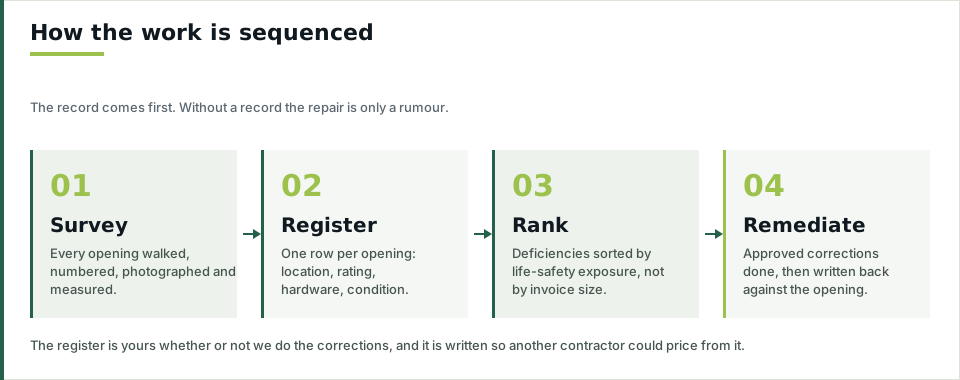
Survey, then schedule, then repair. Almost everything about how this company runs falls out of that order. A first visit to an unfamiliar building is nearly always a survey, even when the call came in about one specific door, because pricing one opening in a building with forty of them tends to produce a decision you would make differently with the full picture in front of you.

Findings come back ranked by exposure. Anything compromising egress or a fire rating sits at the top. Anything likely to fail within a year sits in the middle. Cosmetic damage and wear doing no harm sits at the bottom and is explicitly labelled safe to defer, because a finding sheet that treats a scuffed kick plate the same as an exit device that will not dog is a sheet nobody can budget from.

Then the register gets kept. Every visit, every correction, every measurement, appended to the opening it belongs to. That record is the thing most buildings do not have and the thing every inspector eventually asks for.

Four step diagram of the commercial door survey process: survey, register, rank and remediate
Survey, then schedule, then repair. The register is yours whether or not we do the corrections.
Standards

What this place runs on


Write it down
A finding that exists only in a technician's memory is not a finding. Measurements, photographs, opening numbers, dates.
The label governs
Manufacturer listings and labels override the general rule and override our opinion. If the label on the hinge edge caps the undercut tighter than the standard allows, that is the number.
Decline the work outside the lane
Automatic pedestrian door operators, glass and glazing replacement, dock levellers, and gate operators go to somebody who does them daily.
Rank the findings
Sixty unordered deficiencies is not information. Somebody has to say which one to fix first and be willing to be wrong about it.
Coverage

Where the vans go


Charlotte proper plus Concord, Huntersville, Indian Trail, Fort Mill, Matthews, and Harrisburg. That covers most of Mecklenburg, a good part of Cabarrus and Union, and the York County side across the state line.

Multi-site portfolios spread across that footprint are worth a conversation about a single survey pass rather than site-by-site calls. The register is considerably more useful when it covers everything you own.

Straight answers

Questions about how we operate


Are you the low-cost option?

No. A survey-first model costs more on the first visit and usually less across three years. If a building genuinely needs one door swapped and nothing else, we are the wrong call.

Do you work under a maintenance agreement?

Yes, and it is the arrangement this company is built around. Annual inspection, a scheduled adjustment pass, and a standing register that stays current.

Will you work as a subcontractor to a general contractor?

On door and hardware scope, yes. Purchase order reference and certificate of insurance requirements go to Priya before mobilization.

Can I get the survey without committing to the repairs?

Yes. It is billed as its own line and the document is yours. Several buildings have taken ours and priced the corrections elsewhere, which is a legitimate use of it.

How large a portfolio can you take on?

Realistically, a crew of five surveys faster than it repairs. We will say plainly when a portfolio is beyond what we can schedule rather than accept it and stretch the windows.


Talk it through before anybody quotes it

Ask about a survey, a maintenance agreement, or a single opening you are unsure about.

(333) 333 333

Scoping call, no charge. A number given before anyone has measured the frame is a guess wearing a suit.

Call (333) 333 333