Access Control Hardware in Charlotte, NC
Access control faults get reported as reader faults, and they usually are not. A card presented, a beep, a green light, and a door that stays locked is a door telling you the credential system worked perfectly and something downstream of it did not. Power supply, power transfer, the strike itself, the strike alignment, or a door loop that has been pinched in the hinge since installation. Five candidates, one symptom.
Tell us what is on the door now and what it is doing.
The credential reader is almost never the problem
The reason this matters commercially is that access control integrators and door contractors tend to point at each other across exactly this line. We work the door side of it: the hardware, the transfer, the prep, the alignment, and whether the whole arrangement satisfies egress. Where the fault is genuinely in the head end or the panel, you get told that plainly rather than billed for a morning of looking.
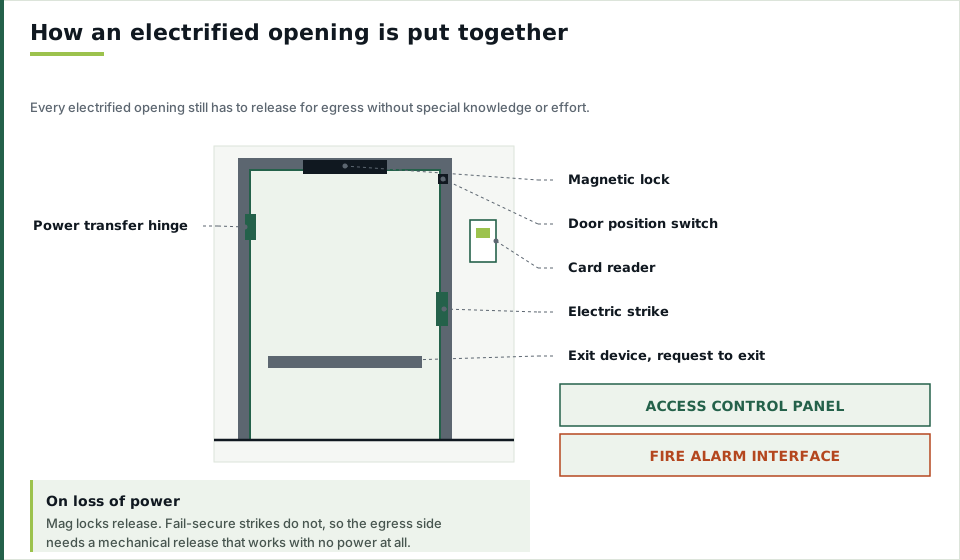
Hardware, and the egress constraints on it
Electrified hardware sits at an awkward intersection: the security requirement wants the door held shut, and life safety requires people be able to get out. Egress provisions in the adopted building and fire codes govern which arrangements are permitted, and they vary by occupancy and by which code edition the authority having jurisdiction has adopted. That is a conversation worth having before hardware is ordered. Retrofitting a compliant arrangement onto a door that was already fitted with a non-compliant one is the most expensive version of this job.
Cost drivers on electrified work
| Driver | Why it matters |
|---|---|
| Existing prep | A frame or leaf already prepped for the device is a fraction of the cost of one that needs cutting, and cutting a rated assembly may not be permitted at all |
| Cable path | Concealed transfer through a hinge is neat and slow. Surface loop is quick and visible. The building usually has an opinion |
| Egress arrangement | Occupancy and adopted code decide the acceptable release scheme, which decides the hardware, which decides the number |
Where an access control integrator already holds the panel and the credentials, we scope only to the door and coordinate the handoff rather than proposing to replace their system.
How an access control call runs
-
01Describe the behaviorWhat the reader does, what the door does, and whether it is consistent or intermittent. Call (984) 402-1347
-
02Establish the openingRated or not, what hardware is fitted, how the cable currently gets across the hinge line.
-
03Isolate the layerSupply, transfer, device, alignment. Measured, not guessed.
-
04Confirm egressThe proposed arrangement gets checked against occupancy and adopted code before parts are ordered.
-
05Fit and cycleInstalled, cycled under load, and left with the finding written against the opening.
What you get that you would not get elsewhere
Other work on the same openings
This page covers hardware with voltage running through it. Mechanical exit devices, closers and locksets that are not tied into a credential system are door hardware and exit device repair.
Talk it through before anybody quotes it
Say whether the opening is fire rated and who holds the access control system.